This post is written in honor of my new friend lydia, whose hometown is Reno.
Sometimes, things connect.
In March 2007 I blogged here about the Austrian photographer Inge Morath.
One of her teachers was Henri Cartier-Bresson whose exhibit we saw and posted about at the weekend.
Lydia left a comment on that post, stating that she would like to see the photo of Marilyn Monroe in Reno because it was her hometown.
And then it clicked.
There's a book by Inge Morath The Road to Reno.
And that's the story:
In 1960, the photographers Inge Morath and Henri Cartier-Bresson set off on a car trip across America, towards Reno. They had been hired by Magnum, a photographic cooperative to cover the making of the movie "The Misfits" (starring Clark Gable and Marilyn Monroe), written by Arthur Miller and directed by John Huston.
All the way long, she collected impressions - photographs and entries in her diary:
"… these are bits of notes written each night at the table in a motel room that was always in a different place but always looked the same."
There's the book's summary and photos to click through.
In Reno she also met Arthur Miller, whom she married after his divorce from Marilyn Monroe and with whom she spent the rest of her life.
In 2007, Inge Morath's book "The Road to Reno" got the award for the most beautiful German book.
And here's how Arthur Miller recalled that first meeting.
5/25/2008


5/23/2008
The Eye of the Century - HCB
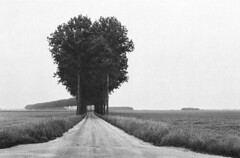
Yesterday we went to the longingly anticipated exhibition „Tête à tête“, of Henri Cartier-Bresson's work in Muenster, Germany.
It was marvellous!
Bresson (1908 – 2004), French photographer and the father of photojournalism is best known for his images of 20th-century artists, authors, scientists, actors, and events. Strongly influenced by surrealism he wanted to capture the „decisive moment“. His photos, mostly taken with a Leica are uncropped and unmanipulated. As he could reach very old age (96) he covered a huge span of events – the first photos date back to the Warsaw ghetto, the Spanish Civil War, the partition of India, especially the funeral of Ghandhi, the Chinese revolution, the student rebellion in France 1968.
In 1947, together with Robert Capa, David Seymour, William Vandivert and others he became a co-founder of Magnum, an international photographic cooperative owned by its photographer members. They saw Magnum as a "community of thought, a shared human quality, a curiosity about what is going on in the world, a respect for what is going on and a desire to transcribe it visually."
Quotes:
"To take a photograph is to align the head, the eye and the heart. It's a way of life."
"The simultaneous recognition, in a fraction of a second, of the significance of an event as well as the precise organization of forms which gives that event its proper expression... . In photography, the smallest thing can be a great subject. The little human detail can become a leitmotif."
My favourites in the exhibit: the portrait of Arthur Miller, sitting at his desk and the portrait of Truman Capote, sitting between huge exotic leaves, taken in 1947.
Here are some of the photos of Tête à tête.
My favorites in general:
Natchez, Mississippi, 1947
Aquila degli Abruzzi, Italy 1951,
Ile de Cité, Paris 1951
Rome, 1959
Palais Royal, Paris 1959
Marilyn Monroe in Reno, 1961
Here's another collection.
It's actually not easy to locate all the photos in the web, therefore I've put as many links as possible.
]
5/18/2008
Generation Y
Is Gen Y going to change the web?
As Sarah Perez points out, the generation Y, roughly defined as „current 13 to 31 year-olds“ (but it goes as far back as 5 ys.) is different.
- they're digital natives
- they're not obsessed with TV
- they don’t care about ads, rather rely on their networks of friends
- for them work isn’t everything, but there has to be fun in it
- they’re socially conscious and care about the world
- they’re going to be the driving force behind technology changes
- they’re social networkers to the core, they grew up in SNs, but they’re also aware of the perils of posting online
I can agree with some of this, because my students are Gen-Yers. What’s not mentioned in the article: the digital divide, the fact that the above applies only to a relatively small percentage of youth. The rest simply lacks the necessary skills to participate in all the web 2.0 activities. A big part of youth have a very limited internet approach, they know and use maybe 5 to 10 websites and that’s it. And it still happens every now and then that I come across a student who hasn't used a search engine even once in his/her life.
As Sarah Perez points out, the generation Y, roughly defined as „current 13 to 31 year-olds“ (but it goes as far back as 5 ys.) is different.
- they're digital natives
- they're not obsessed with TV
- they don’t care about ads, rather rely on their networks of friends
- for them work isn’t everything, but there has to be fun in it
- they’re socially conscious and care about the world
- they’re going to be the driving force behind technology changes
- they’re social networkers to the core, they grew up in SNs, but they’re also aware of the perils of posting online
I can agree with some of this, because my students are Gen-Yers. What’s not mentioned in the article: the digital divide, the fact that the above applies only to a relatively small percentage of youth. The rest simply lacks the necessary skills to participate in all the web 2.0 activities. A big part of youth have a very limited internet approach, they know and use maybe 5 to 10 websites and that’s it. And it still happens every now and then that I come across a student who hasn't used a search engine even once in his/her life.
5/17/2008
Global Food Crisis
Global Voices want to place an overall narrative on the global food crisis with observations from authors all over the world.
Here's the special coverage on the food crisis 2008.
When U.N. Chief Ban Ki-moon was in Austria last month he spoke of a global crisis.
BBC's science correspondent Tom Feilden looks at the reasons for the food crisis and why the era of cheap food may be coming to an end.
There's another interesting article in the Washington Post, which lists as the main reasons:
- trade restrictions on agricultural products
- increasing demand in Asia
- the push to produce biofuels
- weather influences that effected the crops
- the rising fuel prices
I like Global Voices' approach and intention of collecting facts and observations from people all over the world.
Here's the special coverage on the food crisis 2008.
When U.N. Chief Ban Ki-moon was in Austria last month he spoke of a global crisis.
BBC's science correspondent Tom Feilden looks at the reasons for the food crisis and why the era of cheap food may be coming to an end.
There's another interesting article in the Washington Post, which lists as the main reasons:
- trade restrictions on agricultural products
- increasing demand in Asia
- the push to produce biofuels
- weather influences that effected the crops
- the rising fuel prices
I like Global Voices' approach and intention of collecting facts and observations from people all over the world.
5/13/2008
Attention Seeker or Rejecter?
I finally managed to read the interesting Ofcom’s Research Report on Social Networking (dated 2 April 2008), which used a mix of quantitative and qualitative research methods.
SNS (like MySpace, Facebook or Bebo) are of course most popular with teenagers and younger adults. Over one fifth (22%) of adult internet users aged 16+ and
almost half (49%) of children aged 8-17 who use the internet have set up their own profile on a social networking site. For adults, the likelihood of setting up a profile is highest among 16-24 year olds (54%) and decreases with age.
The researchers „detected“ or better, construed distinct groups of social networkers, based on their attitudes and behaviours:
• Alpha Socialisers – (a minority) people who used sites in intense short bursts to flirt, meet new people, and be entertained – the majority is male, under 25.
• Attention Seekers – (some) teens to 35+, especially mothers resp. females who craved attention and comments from others, often by posting photos and customising their profiles.,
• Followers – (many) people who joined sites to keep up with what their peers were doing.
• Faithfuls – (many 20+) people who typically used social networking sites to rekindle old friendships, often from school or university.
• Functionals – (a minority ) people (older males) who tended to be single-minded in using sites for a particular purpose.
Even the non-users of social networking sites fall into distinct groups, based on their reasons for not using social network sites.
• people concerned about safety online, in particular making personal details available online.
• Technically inexperienced – people who lack confidence in using the internet and computers.
• Intellectual rejecters – people who have no interest in social networking sites and see them as a waste of time.
The report or a pdf-presentation can be downloaded here
If you don’t want to read, there’s a video on the findings.
I’m trying to decide where I would place myself within these groups. The main problem is that I’m a member of 2 SNS, but don’t frequent them very often, if so, mainly for research purposes. Does this make me a rejecter? On the other hand, I see how my students often make good use of the sites, they make friends, exchange information, work on their profiles, opinions and values, so basically, I don’t see them as a waste.
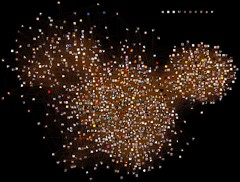
Thanks to Gustavo G for the network poster via flickr.
SNS (like MySpace, Facebook or Bebo) are of course most popular with teenagers and younger adults. Over one fifth (22%) of adult internet users aged 16+ and
almost half (49%) of children aged 8-17 who use the internet have set up their own profile on a social networking site. For adults, the likelihood of setting up a profile is highest among 16-24 year olds (54%) and decreases with age.
The researchers „detected“ or better, construed distinct groups of social networkers, based on their attitudes and behaviours:
• Alpha Socialisers – (a minority) people who used sites in intense short bursts to flirt, meet new people, and be entertained – the majority is male, under 25.
• Attention Seekers – (some) teens to 35+, especially mothers resp. females who craved attention and comments from others, often by posting photos and customising their profiles.,
• Followers – (many) people who joined sites to keep up with what their peers were doing.
• Faithfuls – (many 20+) people who typically used social networking sites to rekindle old friendships, often from school or university.
• Functionals – (a minority ) people (older males) who tended to be single-minded in using sites for a particular purpose.
Even the non-users of social networking sites fall into distinct groups, based on their reasons for not using social network sites.
• people concerned about safety online, in particular making personal details available online.
• Technically inexperienced – people who lack confidence in using the internet and computers.
• Intellectual rejecters – people who have no interest in social networking sites and see them as a waste of time.
The report or a pdf-presentation can be downloaded here
If you don’t want to read, there’s a video on the findings.
I’m trying to decide where I would place myself within these groups. The main problem is that I’m a member of 2 SNS, but don’t frequent them very often, if so, mainly for research purposes. Does this make me a rejecter? On the other hand, I see how my students often make good use of the sites, they make friends, exchange information, work on their profiles, opinions and values, so basically, I don’t see them as a waste.
Thanks to Gustavo G for the network poster via flickr.
5/12/2008
Cuckoo-Search
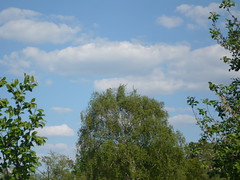
Yesterday, I heard a cuckoo! We took a walk near the Rieselfelder in Muenster (a huge bird sanctuary in a wet marsh area) - and there it was! Cuckoo-ing along, for quite a while.
I was fairly exited, as I hadn't heard one in years.
Actually, it can be seen on the birch, with a little effort and enlargening tools...
I was fairly exited, as I hadn't heard one in years.
Actually, it can be seen on the birch, with a little effort and enlargening tools...
5/06/2008
Discovering Kiefer
Last weekend we went to the Essl Museum near Vienna, to an exhibition of masterpieces of the German and Austrian painters Georg Baselitz, Markus Lüpertz, Anselm Kiefer, Gerhard Richter, Sigmar Polke, Arnulf Rainer and Maria Lassnig.
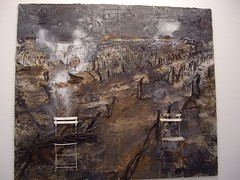
I am impressed by Sigmar Polke and Gerhard Richter, but I was overwhelmed by the works of Anselm Kiefer. I had heard of him, but I was not prepared for this deep symbolism, especially in "For Paul Celan 2005", with lines from a poem by Paul Celan, or "Sternenfall 1998" (Falling Stars). I could have stood there for hours and just get lost in the atmosphere and the details.
A short extract from Wikipedia:
Kiefer ranks among the best-known and most successful, but also most disputed German artists after World War II. In his entire body of work, Kiefer argues with the past and addresses taboo and controversial issues from recent history. Themes from Nazi rule are particularly reflected in his work; for instance, the painting "Margarethe" (oil and straw on canvas) was inspired by Paul Celan's well-known poem "Todesfuge" ("Death Fugue"). Polemical discussions in the media over the value of his artistic work have taken place for many decades.
His works are characterised by a dull/musty, nearly depressive, destructive style and are often done in large scale formats. In most of his works, the use of photography as an output surface is prevalent and earth and other raw materials of nature are often incorporated. It is also characteristic of his work to find signatures and/or names of humans, legendary figures or places particularly pregnant with history in nearly all of his paintings. All of these are encoded sigils through which Kiefer seeks to process the past; this often gets him linked with a style called "New Symbolism."
I am impressed by Sigmar Polke and Gerhard Richter, but I was overwhelmed by the works of Anselm Kiefer. I had heard of him, but I was not prepared for this deep symbolism, especially in "For Paul Celan 2005", with lines from a poem by Paul Celan, or "Sternenfall 1998" (Falling Stars). I could have stood there for hours and just get lost in the atmosphere and the details.
A short extract from Wikipedia:
Kiefer ranks among the best-known and most successful, but also most disputed German artists after World War II. In his entire body of work, Kiefer argues with the past and addresses taboo and controversial issues from recent history. Themes from Nazi rule are particularly reflected in his work; for instance, the painting "Margarethe" (oil and straw on canvas) was inspired by Paul Celan's well-known poem "Todesfuge" ("Death Fugue"). Polemical discussions in the media over the value of his artistic work have taken place for many decades.
His works are characterised by a dull/musty, nearly depressive, destructive style and are often done in large scale formats. In most of his works, the use of photography as an output surface is prevalent and earth and other raw materials of nature are often incorporated. It is also characteristic of his work to find signatures and/or names of humans, legendary figures or places particularly pregnant with history in nearly all of his paintings. All of these are encoded sigils through which Kiefer seeks to process the past; this often gets him linked with a style called "New Symbolism."
Subscribe to:
Posts (Atom)