Last weekend we went to the Essl Museum near Vienna, to an exhibition of masterpieces of the German and Austrian painters Georg Baselitz, Markus Lüpertz, Anselm Kiefer, Gerhard Richter, Sigmar Polke, Arnulf Rainer and Maria Lassnig.
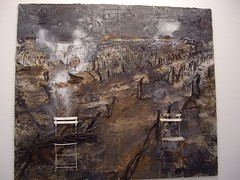
I am impressed by Sigmar Polke and Gerhard Richter, but I was overwhelmed by the works of Anselm Kiefer. I had heard of him, but I was not prepared for this deep symbolism, especially in "For Paul Celan 2005", with lines from a poem by Paul Celan, or "Sternenfall 1998" (Falling Stars). I could have stood there for hours and just get lost in the atmosphere and the details.
A short extract from Wikipedia:
Kiefer ranks among the best-known and most successful, but also most disputed German artists after World War II. In his entire body of work, Kiefer argues with the past and addresses taboo and controversial issues from recent history. Themes from Nazi rule are particularly reflected in his work; for instance, the painting "Margarethe" (oil and straw on canvas) was inspired by Paul Celan's well-known poem "Todesfuge" ("Death Fugue"). Polemical discussions in the media over the value of his artistic work have taken place for many decades.
His works are characterised by a dull/musty, nearly depressive, destructive style and are often done in large scale formats. In most of his works, the use of photography as an output surface is prevalent and earth and other raw materials of nature are often incorporated. It is also characteristic of his work to find signatures and/or names of humans, legendary figures or places particularly pregnant with history in nearly all of his paintings. All of these are encoded sigils through which Kiefer seeks to process the past; this often gets him linked with a style called "New Symbolism."
Showing posts with label arts. Show all posts
Showing posts with label arts. Show all posts
5/06/2008


3/24/2007
Yves Klein, again
BEAU-TI-FUL!
I went to the Yves Klein-Exhibit today! Those monochromes in gold, blue, pink! Those smoky compositions! Those sponge sculptures!
Much much better than I had imagined.
I'm not one for too many earthly possessions, but for a moment I thought: Oh, if I could only be a collector of paintings...
I went to the Yves Klein-Exhibit today! Those monochromes in gold, blue, pink! Those smoky compositions! Those sponge sculptures!
Much much better than I had imagined.
I'm not one for too many earthly possessions, but for a moment I thought: Oh, if I could only be a collector of paintings...
3/08/2007
The Blue Revolution - IKB =PB29, =CI 77007
This is a tribute to Yves Klein: one webpage entirely in the Klein Blue!
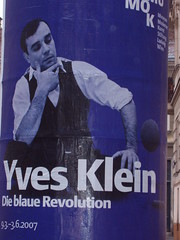
The Blue Revolution can be seen in Vienna from today until 3 June 2007. There's an Yves Klein retrospective in the MUMOK in Vienna, in cooperation with the Centre Pompidou in Paris.
I haven't seen it yet, but will do so ere long.
Yves Klein is the "inventor" of monochrome painting, concept artist, performative artist. He painted in pink and gold, but later almost exclusively in this deep blue you can see via the link on top - patented as International Klein Blue. To him, this was the purest of all colours. The exhibit comprises more than 120 paintings, sculptures, manifestos and drawings from important private and public collections in France, the USA and Japan plus original films and documents.
Take a look at Mumok's Image Gallery to see those beautiful blue things.
In the Klein Archives you'll find some more.
The Blue Revolution can be seen in Vienna from today until 3 June 2007. There's an Yves Klein retrospective in the MUMOK in Vienna, in cooperation with the Centre Pompidou in Paris.
I haven't seen it yet, but will do so ere long.
Yves Klein is the "inventor" of monochrome painting, concept artist, performative artist. He painted in pink and gold, but later almost exclusively in this deep blue you can see via the link on top - patented as International Klein Blue. To him, this was the purest of all colours. The exhibit comprises more than 120 paintings, sculptures, manifestos and drawings from important private and public collections in France, the USA and Japan plus original films and documents.
Take a look at Mumok's Image Gallery to see those beautiful blue things.
In the Klein Archives you'll find some more.
2/28/2007
documenta12
2007 is documenta-year! The documenta is one of the world‘s most important and interesting exhibitions of modern and contemporary art. It takes place only every five years in Kassel, Germany. This year we’ll have the 12th documenta from 16 June to 23 September.
I was at the documenta11 and was rather impressed, especially by some of the works of former documentas which are still present in the city of Kassel, e.g. the 7000 oaks by Joseph Beuys or the huge pickaxe by Claes Oldenburg.
The first issue of the documenta 12 Magazine was presented at the Wiener Secession on Feb 26. “Modernity?” addresses one of the three documenta 12 leitmotifs posed by Roger M. Buergel (the curator) and Ruth Noack: "Is modernity our antiquity?" and deals with the influence of modernity on artists and the question of modernity itself.
The other leitmotifs are: What is bare life? (and explores several dimensions of being), the third one: What is to be done? (this deals with the “educating part” - Artists educate themselves by working through form and subject matter; audiences educate themselves by experiencing things aesthetically; and it deals also with the question of mediating content without sacrificing their particularity).
In an interview in the Austrian daily newspaper “DerStandard” the curator of this year’s documenta, Roger M. Buergel talked today about the different kinds of modernity in different cultures and for fragmented groups in fragmented societies. He gave the example of Moroccan teens in Amsterdam who were excluded from the Anti-American protests because they wanted to burn the flag – on the other hand they are excluded from taking political influence within the structures.
I was at the documenta11 and was rather impressed, especially by some of the works of former documentas which are still present in the city of Kassel, e.g. the 7000 oaks by Joseph Beuys or the huge pickaxe by Claes Oldenburg.
The first issue of the documenta 12 Magazine was presented at the Wiener Secession on Feb 26. “Modernity?” addresses one of the three documenta 12 leitmotifs posed by Roger M. Buergel (the curator) and Ruth Noack: "Is modernity our antiquity?" and deals with the influence of modernity on artists and the question of modernity itself.
The other leitmotifs are: What is bare life? (and explores several dimensions of being), the third one: What is to be done? (this deals with the “educating part” - Artists educate themselves by working through form and subject matter; audiences educate themselves by experiencing things aesthetically; and it deals also with the question of mediating content without sacrificing their particularity).
In an interview in the Austrian daily newspaper “DerStandard” the curator of this year’s documenta, Roger M. Buergel talked today about the different kinds of modernity in different cultures and for fragmented groups in fragmented societies. He gave the example of Moroccan teens in Amsterdam who were excluded from the Anti-American protests because they wanted to burn the flag – on the other hand they are excluded from taking political influence within the structures.
Subscribe to:
Posts (Atom)