Showing posts with label Vienna. Show all posts

2/06/2013

Dan Flavin: Situations

Saw the exhibit (in January) at Vienna's Mumok of US artist Dan Flavin "Lights". Steve Morse, who had managed Dan Flavin's studio over a period of five years and is still in charge of the presentations of Flavin's fluorescent tubes in an interview with the Austrian daily "DerStandard" titled "He was so polite as to accept compliments":
People would ask Dan Flavin: "Do you do sculptures"? "No". "Do you do lightart"? "No". "Do you do environments"? "No". "So what are you doing?" "I'm creating situations".
Powerful situations. And demanding ones.

9/30/2010

Promises

A promising young man indeed: Listen to James Hersey, US-American songwriter, raised biculturally in and around Vienna.

5/30/2010

Riddle

Discovered in Vienna's public transport yesterday. Which pictogram is the odd one out?

4/25/2010

I viewed the mist and missed the view

That's what Mark Twain said when he reached the top of a mountain trail in the vicinity of Vienna.

Mark Twain spent most of the years 1897 and 1898 in Austria, and according to Carl Dolmetsch who wrote bis biography "Our Famous Guest", those 20 months were quite a prolific time.

Austria, especially Fin-de-siecle Vienna, had an impressive intellectual elite then, with Sigmund Freud, Gustav Klimt, Theodor Herzl, Ludwig Wittgenstein, Karl Kraus, Gustav Mahler, to name but a few outstanding names.

This week, on the occasion of the Mark Twain Centennial, a commemorative plaque was unveiled at the Hotel Ambassador, the former Hotel Krantz, where Twain spent most of his time in Austria.

There are some nice stories about Mark Twain's stay in Vienna here and here.

Some references in Twain's work to Vienna and Austria can be found in The Appetite Cure.

In 1897, Twain spoke to the Concordia Press Club in Vienna as a special guest about "The Horrors of the German Language", in German, to the amusement of the audience.

Here's the essay "The Awful German Language".

Notes and quotes on the German language:

A dog is "der Hund"; a woman is "die Frau"; a horse is "das Pferd"; now you put that dog in the genitive case, and is he the same dog he was before? No, sir; he is "des Hundes"; put him in the dative case and what is he? Why, he is "dem Hund." Now you snatch him into the accusative case and how is it with him? Why, he is "den Hunden." But suppose he happens to be twins and you have to pluralize him- what then? Why, they'll swat that twin dog around through the 4 cases until he'll think he's an entire international dog-show all in is own person. I don't like dogs, but I wouldn't treat a dog like that--I wouldn't even treat a borrowed dog that way. Well, it's just the same with a cat. They start her in at the nominative singular in good health and fair to look upon, and they sweat her through all the 4 cases and the 16 the's and when she limps out through the accusative plural you wouldn't recognize her for the same being. Yes, sir, once the German language gets hold of a cat, it's goodbye cat. That's about the amount of it.

3/16/2010

Happy St. Patrick's Day!

St. Patrick's Day in Vienna in 1776, (I would never have thought that it went that far back) and in 2010, celebrated as a cultural festival with a parade.

Fortunately, I'm not ill any longer, so I just might watch the parade or go to the film night.

And then I found this video on Youtube:

7/31/2009

The Danube


I strolled along the Danube, the longest river in the European Union (2850 km) today. Well, not all of those kilometres ... It was very hot, the heat softened by a light breeze. Pleasant.

The river originates in Germany's Black Forest, passes through ten countries (Germany, Austria, Slovakia, Hungary, Croatia, Serbia, Romania, Bulgaria, Moldova and Ukraine).

The Danube basin was the site of some of the earliest human cultures such as the Linear Pottery Culture (5500–4500 BC). The river was part of the Roman empire's Limes Germanicus. The Romans often used the river Danube as a border for their empire.

Here's more on the river.

My favorite Danube books are Claudio Magris'" Danube - A sentimental journey from the source to the Black Sea, a fascinating mixture of history, literature, philosophy and travelogue, and Inge Morath's photo book Danube.


Everybody knows the Waltz The Blue Danube by Johann Strauss II. The Danube is seldom blue, more often greyish or even brownish, by the way.

Here's an interpretation by Faryl Smith, called "The River of Light".


The German poet Friedrich Hoelderlin called the Danube "a refreshing, melodious river, sometimes foaming with high spirits, at other times dreaming serenely.”

6/28/2009

The Graffiti Artist: Cy Twombly


The American artist Edwin Parker (Cy) Twombly Jr (born April 25, 1928) has an exhibit in Vienna's Mumok.


Twombly is known for his gestural, calligraphic-style graffiti paintings with letter-like signs, his scribbling and doodling, his symbols of ancient mythology on monumental canvases.

I have the feeling it will need some time to get closer to Twombly's work, some of the pictures have impressed me very much, because of their radiant colours, their vibrancy and irony. For example, I was very attracted by the "Wilder Shores of Love"(see above).

Here's an interview with the artist and below a video from the Tate where the Tate's Director Nicholas Serota gives a behind the scenes tour of the Cy Twombly exhibition as he makes the final adjustments to the hang just before opening. Serota talks about Twombly's technique, his relationship to Turner, and how the artist, now in his eighties, is still producing some of the most vital work of his career.

6/17/2009

Was Leopold Bloom Austrian?

I promised to blog about Bloomsday 2009 in Vienna.

It was a hot Bloomsday, and the small art lounge in the basement of the Café Korb which takes pride in a lot of famous former guests like Arthur Miller or Andy Warhol was like a sauna. The readings were transmitted to the bigger room on the first floor where it was much cooler – but I wanted authenticity, and this meant sweating and drinking lots of water and some wine. Additionally, more than half of the audience of about 40 people smoked as if there was no tomorrow, which meant a slight feeling of anoxia and poor visibility.

The reading was non-stop. One advertising canvasser (or of a similar occupation) after the other was called by name and company, got the text and started reading, each one about 10 minutes. I have never read the German translation of Ulysses, although I own one, and was astonished how different some passages come across in another language. I hadn’t been at a reading for a long time, but found it very stimulating to listen for once and concentrate on the voices and the puns. And it was fun, too. By 11.30 we had seen and heard 32 people from newspapers, radios and TV-stations.

There was one contribution in English, read by Dardis McNamee from the Vienna Review, an English-language newspaper in Vienna. It was great to hear at least several pages of the original.

The readings were framed by the talks of three Joyce connoisseurs: Kurt Palm, director and author (of, amongst others, a James Joyce-ABC), Meinhard Rauchensteiner, advisor to the Federal President and Otto Brusatti, radio presenter and musicologist.

The people over here like connections to their own country, so Kurt Palm recounted that the first lines of „Ulysses“ were written in Trieste, which, at that time was Austrian.

Mr Rauchensteiner asked „Was Leopold Bloom Austrian?“ and presented references to Austria found in Ulysses. There are quite a few. For example the following passage from episode 7, Aeolus: „Emperor’s horses. Habsburg. An Irishman saved his life on the ramparts of Vienna. Don’t you forget! Maximilian Karl O’Donnell, graf von Tirconnell in Ireland. Sent his heir over to make the king an Austrian fieldmarshal now. Going to be trouble there one day. Wild geese. O yes, every time. Don’t you forget that!“

The background to this: Maximilian Karl Lamoral Count O’Donnell, Austrian born son of an Irish expatriate served as aide-de-camp to Emperor Francis Joseph. One day, he attended the emperor on his daily walk around Vienna.When the Emperor was attacked and wounded by a Hungarian tailor, O’Donnell knocked the man down. The Emperor subsequently asserted that he owed his life to O’Donnell.

The „Wild Geese“ refers to the large groups of people who left Ireland between 1600 and 1789, most of them to serve in the huge continental armies of Russia, Spain, Poland, France and Austria. One of them was the Irishman Maximilian Ulysses Browne, but we can’t be sure if his second name had any influence on the title of the book.

The question „Was Leopold Bloom Austrian“? was finally answered with „Yes, but only in his nightmares“.

I did not stay for the talk „Joyce and Music“ which is a pity but it was around midnight and I had to get up at 5. I’m sure the readings went on till the wee hours of the morning.

An evening well spent.

6/15/2009

Bloomsday 2009 in Vienna


There are several events to celebrate Bloomsday here in Vienna, but one of them sounds very interesting and promising.

Staged by a town magazine (Wien live) lots of people will read non-stop from James Joyce's "Ulysses" in one of Vienna's most famous coffeehouses, the "Café Korb" - "until exhaustion". And very special people, too: advertising canvassers, people who have the same job as the fictitious Leopold Bloom, protagonist and anti-hero in "Ulysses". They will do so with the express permission of James Joyce's grandson, Stephen James Joyce.

The canvassers will be coming from all of Vienna's daily newspapers, and they will additionally be boosted by editors and publishers who have been forced to ask companies for support in exchange for an - advert.

Gorgonzola sandwiches with mustard and burgundy will be served, the snack Leopold Bloom ate in Davy Byrne's on Grafton Street in Dublin.

2/18/2009

Gerhard Richter again

After having seen the beautiful glass windows of the Cologne Cathedral created by Gerhard Richter we went to the Albertina retrospective in Vienna.

“I pursue no objectives, no system, no tendency; I have no program, no style, no direction…. I steer clear of definitions. I don’t know what I want. I am inconsistent, non-committal, passive; I like the indefinite, the boundless; I like continual uncertainty", says Richter who leads the list of the most sought-after painters in the world, followed by Bruce Nauman, Sigmar Polke and Georg Baselitz.

He may not pursue anything, but the effects are pretty strong. His versatility impressed me most. The Albertina shows about 150 photorealistic paintings, abstract oil paintings, watercolours and drawings and covers many different phases of a painter's life.

I might go there for a second time.

11/04/2007

Vic Chesnutt in Vienna


Splendidly...
Originally uploaded by us.kids.know
On Friday we were at a concert of Vic Chesnutt and his band in Vienna’s Gartenbaukino. I had seen Vic before – he looked even more frail than the last time (some three years ago in Essen) but his voice was intense as ever, changing from quiet to aggressive to tender, sometimes all of these in a few lines of song. The black-humor contents of mortality and loss matched the black day (All Soul’s Day) just fine.

And the band (Efrim Menuck, Jessica Moss, Thierry Amar, Eric Craven (Silver Mt. Zion), Guy Picciotto (Fugazi)) who seems to be an assembly of interesting individuals was marvellously in accordance and at the same time a contrast to Vic.

We heard mostly songs from his new album "North Star Deserter" and one aweseome „Ruby Tuesday“ as an encore.

More in German on Stevie’s blog.

The beautiful photo is from us.kids.know.

5/30/2007

Teletubbies and other gay people

Finally, there's a remake of the old discussion: Is Tinky Winky gay?, triggered out by Eva Sowinksa, spokesperson for children's rights in Poland - after she realized Tinky Winky carried - oh my God! - a handbag, which makes him a) gay and b) if that were the case a harmful role model for other children.

It was also in Poland where they wanted to sack teachers because of homosexuality.

Let's take a look at the scandalous entertainment:


Related topic: The Life ball, Europe's largest AIDS charity event and the only one that takes place in a political building, the City Hall of Vienna, was a huge success. 4000 paying visitors, 40000 watching the beautiful costumes. Last year's ball brought more than 1 million Euros.

3/24/2007

Yves Klein, again


Yves Klein
Originally uploaded by francessa_Rich.
BEAU-TI-FUL!

I went to the Yves Klein-Exhibit today! Those monochromes in gold, blue, pink! Those smoky compositions! Those sponge sculptures!

Much much better than I had imagined.

I'm not one for too many earthly possessions, but for a moment I thought: Oh, if I could only be a collector of paintings...

3/08/2007

The Blue Revolution - IKB =PB29, =CI 77007

This is a tribute to Yves Klein: one webpage entirely in the Klein Blue!

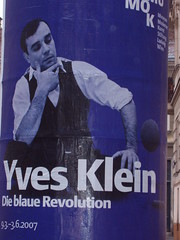
The Blue Revolution can be seen in Vienna from today until 3 June 2007. There's an Yves Klein retrospective in the MUMOK in Vienna, in cooperation with the Centre Pompidou in Paris.

I haven't seen it yet, but will do so ere long.

Yves Klein is the "inventor" of monochrome painting, concept artist, performative artist. He painted in pink and gold, but later almost exclusively in this deep blue you can see via the link on top - patented as International Klein Blue. To him, this was the purest of all colours. The exhibit comprises more than 120 paintings, sculptures, manifestos and drawings from important private and public collections in France, the USA and Japan plus original films and documents.

Take a look at Mumok's Image Gallery to see those beautiful blue things.

In the Klein Archives you'll find some more.
Related Posts with Thumbnails